We earn a commission if you buy through our links, at no extra cost to you.
Best Dash Cam for Trucks: Pickups to Semis (2026)
How to choose a dash cam for a pickup, box truck or semi: 12/24V power, rear cable length, waterproof rear cameras, heat, mounting and FMCSA windshield limits.
At a glance
For trucks, pick for power and rear coverage. The Vantrue N4 Pro S has a waterproof rear camera that can mount outside, and the Thinkware U3000 PRO lists a 12V or 24V input. The VIOFO A329S offers rear cables up to 66 ft (20 m) for semis, and the ROVE R2-4K Dual Pro plugs into a 12V socket.


A dash cam in a pickup is a straightforward purchase. A dash cam in a box truck or a semi is not, because the vehicle is longer, the electrical system may run on 24V, the cab gets hot and the rules for what can sit on the windshield are stricter. This guide walks through those differences and shows which of the models we cover fit each situation. We drew on published manuals and manufacturer pages, so every figure here is attributed to its maker.
Our overall lineup is in the dash cam ranking for 2026. This page is about what changes when the vehicle is a truck.
What Changes on a Truck
Five things separate truck installs from car installs.
- Power. Many pickups run on 12V, but heavy trucks often run on 24V. A camera built only for 12V can be damaged on 24V, so the input voltage the manufacturer lists matters more than anything else on the box.
- Cable length. The rear camera has to be wired back to the front unit. In a long cab or a box truck, a default cable may not reach.
- Rear camera housing. Box trucks may have no rear window at all, and pickups have one a long way from the driver. A waterproof camera that can mount outside solves that.
- Heat and cold. A parked cab bakes. A supercapacitor handles heat better than a lithium battery, but every camera has an operating range.
- Mounting rules. Federal and state rules limit where devices may go on the windshield, and commercial drivers should also check their employer’s policy.
Power: 12V, 24V and What the Manuals Say
Read the input specification before you buy. Thinkware’s manual lists the U3000 PRO power input as DC 12 or 24V, and the rear camera as DC 5V. VIOFO says its HK6 hardwire kit supplies constant 12 to 24V power for the A329S series. Garmin’s manuals for the Mini 3 and X310 describe a constant power cable that plugs into the OBD II port, and the specifications list a 12 to 16V input, so Garmin’s parking accessories are built around 12V vehicles.
Vantrue’s page for the N4 Pro S lists no input voltage that we could find, and the ROVE page describes a car charger that plugs into the 12V socket without stating 24V support. If your truck is 24V, ask the manufacturer in writing before you connect either one, or have a professional install a properly rated step-down converter.
The same caution applies to parking mode. Thinkware warns that connecting to a continuously powered outlet may drain the car battery, and its guide strongly recommends professional installation for the hardwiring cable. On a truck, a drained battery is more than an annoyance, so use a low-voltage cutoff and have a shop install it if you are not comfortable at the fuse panel.
Vantrue N4 Pro S: Waterproof Rear Camera for Outside Mounting
Its IP67 waterproof rear camera is made to mount inside or outside, which helps on pickups, vans and box trucks. It also adds an infrared cabin camera and a supercapacitor.
According to Vantrue, the rear camera records at 2.5K, carries an IP67 rating and is suitable for interior or exterior mounting. The front camera records 4K and the cabin camera records 1080p with infrared LEDs, which is useful for fleet or delivery work with a co-driver or passengers. Vantrue says the unit uses a supercapacitor for extreme temperatures and supports microSD cards up to 1 TB. The 24/7 parking guard needs a hardwire kit, sold separately.
The page gives no rear cable length or input voltage, so check the box contents and ask Vantrue before wiring a long vehicle. See the Vantrue N4 Pro S profile for the full specs.
Thinkware U3000 PRO: The Listed 12V and 24V Input
Thinkware lists a 12V or 24V DC input, a supercapacitor and radar-assisted parking mode, which suits trucks parked on the street or in a yard.
This is the only model among those we compared where the manufacturer’s manual states 24V support. Thinkware also lists an operating range of 14°F to 140°F, a supercapacitor as the auxiliary power unit and a Thermal Protection setting that switches the camera to energy saving mode when the inside of the vehicle gets too hot. Parking mode works only with the hardwiring cable, or the OBD-II cable in the OBD configuration. The rear camera is designed to mount on the inside of the rear windshield with an adhesive pad, so it suits trucks with a rear window better than box trucks.
The kit sold here is front and rear with an LTE module, which can help a fleet owner who wants alerts away from Wi-Fi, though connected features need a data plan. Details are in the Thinkware U3000 PRO profile.
VIOFO A329S: Choose the Cable to Fit the Truck
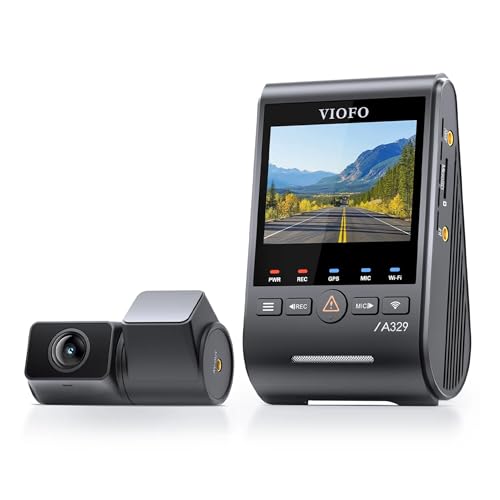
VIOFO sells rear cables from about 20 ft (6 m) to 66 ft (20 m) and says the longest suits semi-trucks, with a 12 to 24V hardwire kit for parking mode. Check the length in your listing.
VIOFO’s FAQ is unusually specific about vehicle length: the default 20 ft (6 m) cable is enough for most sedans and compact SUVs, with 26 ft (8 m) for mid-size SUVs, 33 ft (10 m) for full-size SUVs and pickups, 49 ft (15 m) for vans and commercial vehicles and 66 ft (20 m) for semi-trucks. The listing here is the 2CH kit, so confirm which cable length is in the box. VIOFO lists a supercapacitor, an operating range of -4°F to 149°F, and an HK6 hardwire kit rated for 12 to 24V.
The standard rear camera is not waterproof. VIOFO sells a waterproof edition as a separate product, so pickup and box truck owners who want an outside mount should look there. Our VIOFO A329S profile covers the editions.
ROVE R2-4K Dual Pro: A Plug-In Option for Pickups

A kit that plugs into the 12V socket: ROVE lists a 12 ft power cable, a 21 ft (6.5 m) rear cable and a suction mount that lifts off the glass. Best for pickups and light trucks.
ROVE’s page describes an install that ends with the car charger in the cigarette lighter socket and a 12 ft cable for the front camera. The rear camera uses a 21 ft (6.5 m) USB-C cable, and ROVE sells a 30 ft (9 m) extra-long rear cable for this model separately. The kit includes a suction mount and a spare adhesive mount, and a built-in supercapacitor. ROVE lists a 24-hour parking monitor, which needs constant power, so a hardwire kit is required. ROVE’s page does not state 24V compatibility. See the ROVE R2-4K Dual Pro profile for details.
Heat, Cards and Mounting
All four models list a supercapacitor, which is the sensible choice for a cab that sits in the sun. Supercapacitors do not make a camera immune to heat, so use a sunshade, avoid direct sun on the lens when possible, and respect the operating ranges the makers list. A high-endurance microSD card also matters, because loop recording rewrites the card all day.
For mounting, use the adhesive or suction mount on a clean, dry windshield and route cables behind trim so they do not interfere with the driver’s view or controls. Garmin’s manual says to avoid placing a camera behind a tinted area and to make sure the area in front of the lens is cleared by the wipers, which is good advice for any camera.
FMCSA Rule on Windshield Devices
For commercial motor vehicles, 49 CFR 393.60 covers glazing and what may be mounted on the windshield. As published by the Cornell Legal Information Institute, paragraph (e)(1)(i) says antennas and similar devices must not be mounted more than 6 inches (152 mm) below the upper edge of the windshield, must be located outside the area swept by the wipers, and must be outside the driver’s sight lines to the road and highway signs and signals. Paragraph (e)(1)(ii) makes an exception for “vehicle safety technologies” as defined in 49 CFR 393.5, which may be mounted not more than 8.5 inches (216 mm) below the upper edge of the area swept by the wipers and not more than 7 inches (175 mm) above its lower edge, and outside the driver’s sight lines.
We are not lawyers, so we cannot say whether a given dash cam counts as a vehicle safety technology. If you drive under FMCSA rules, ask your carrier or compliance contact. Non-commercial drivers should check their own state’s windshield rules, which vary.
Which One for Which Truck?
- Pickup with a 12V socket: the ROVE R2-4K Dual Pro is a simple plug-in kit, and the VIOFO A329S fits with a 33 ft (10 m) rear cable.
- Box truck or van with no rear window: the Vantrue N4 Pro S, because its rear camera is waterproof and made for outside mounting.
- 24V heavy truck: the Thinkware U3000 PRO is the only one here with a manufacturer-listed 24V input.
- Semi: VIOFO’s 66 ft (20 m) rear cable is the only one of the four that its maker ties to semi-trucks, and you should still confirm the voltage first.
For the full list, see our dash cam comparison.
Sources
- Vantrue N4 Pro S official product page
- Thinkware U3000 PRO official English user guide (PDF)
- VIOFO A329S 2CH official product page
- ROVE R2-4K Dual Pro official product page
- Garmin Dash Cam Mini 3 owner’s manual (PDF)
- Garmin Dash Cam X310 owner’s manual (PDF)
- 49 CFR 393.60, Cornell Legal Information Institute
Frequently asked questions
Do dash cams work on 24V trucks?
Only if the maker says so. Thinkware lists a 12V or 24V DC input for the U3000 PRO, and VIOFO lists its HK6 hardwire kit for 12 to 24V. Garmin lists a 12 to 16V input for its parking cables. Always confirm the voltage before connecting a camera to a 24V system.
How long a rear cable do I need on a semi?
It depends on how far the rear camera sits from the front unit. VIOFO says its default 20 ft (6 m) cable fits most sedans and compact SUVs, and suggests 33 ft (10 m) for full-size SUVs and pickups, 49 ft (15 m) for vans and commercial vehicles and 66 ft (20 m) for semi-trucks. Measure your own route.
Can a dash cam go behind the trailer?
These kits run a cable from the front unit to the rear camera, so they cover the area behind the cab or box, not a detachable trailer. Check the cable length and your plan before buying.
Will heat damage a dash cam in a parked truck?
Heat is the main risk to cameras with lithium batteries. All four models here list a supercapacitor, but each has an operating limit, such as Thinkware's 140°F, so use a sunshade where you can.
Where can I mount a dash cam on a commercial truck?
Federal rules limit where devices may sit on a windshield, and states add their own. Read 49 CFR 393.60 and your employer's policy, and place the camera outside the area swept by the wipers and out of the driver's sight lines.